(Thirteenth in a series)
SpaceX’s Starship had a test flight on Sept. 28, 2026, sending the Starship second stage into orbit for the first time. The company deployed Starlink satellites, conducted a successful Starship deorbit burn, and flew both the booster and Starship to gentle ocean splashdowns. But we need Starship on the Moon, and on this flight, the Starship lost an engine on the way to Earth orbit—not a good sign for engines intended for lunar landing. SpaceX is following the Apollo model of lunar lander testing: NASA tested the LM around Earth first, then around the moon before Neil and Buzz flew the LM to the surface. Now, SpaceX must move quickly to prove it can manage multiple orbital refuelings, and demonstrate a robotic lunar landing and ascent.

While we watch SpaceX’s Starship progress and a first flight for Blue Origin’s ‘Blue Moon’ lander prototype, we can look forward to continued robotic exploration.
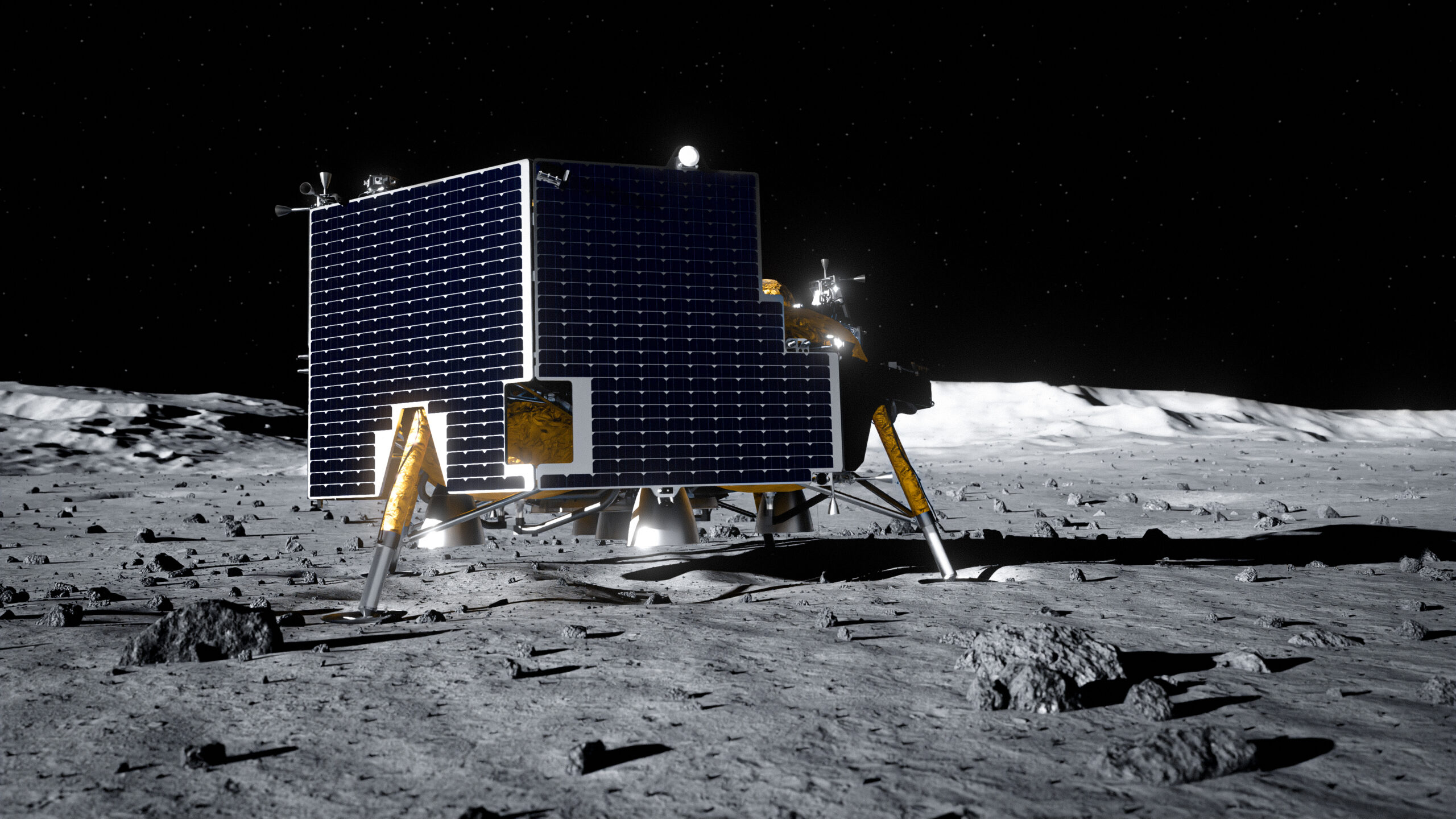
Late in 2026, Voyager Technologies plans to send its first Griffin lander to the lunar south pole. Voyager’s lander is to touch down at Mons Mouton, a high point near the lunar south pole. , García-Galán said, carrying a robotic FLIP rover from Astrolab to test hardware for a future crewed rover NASA plans to launch
NASA’s international coalition will send rovers into the Moon’s cold, shadowed craters to locate ice deposits. If found and characterized, that ice could be harvested by an automated mining plant and processed into clean water. The water would supply a lunar outpost with drinking water and oxygen, and could be converted into rocket propellant. Another critical resource for the outpost will be energy, supplied by both nuclear reactors and solar arrays. It may take ten years after our initial lunar return to set up ice mining on a commercial scale, produced under contract to NASA and its partners. Just this week, Blue Origin announced a 10-kW solar power tower, delivered atop a Blue Moon lander.
NASA will need progress on multiple fronts to make Artemis human expeditions to the Moon a reality. We’ve noted the high launch cost of the NASA-purchased SLS; it will face stiff competition from Starship and Blue Origin’s New Glenn rockets. But right now, Space Launch System is the only heavy-lift Moon rocket that’s actually on the pad right now.
Aside from heavy-lift boosters, NASA will also need a new lunar spacesuit. What I wore on my EVAs on the space station is too heavy a suit for even the Moon’s reduced gravity, and that shuttle/ISS EMU is not flexible enough in the legs and torso to maneuver on the surface. A new exploration suit is under contract from Axiom Space, now directed by NASA to produce a lighter, simpler “sortie suit” for earlier Moon missions.

The Artemis crews will need a surface rover for long-range mobility. NASA has picked two teams to develop Lunar Terrain Vehicle (LTV) prototypes: The Pegasus will be developed by a team led by Lunar Outpost in partnership with General Motors, Goodyear, and Leidos; the CLV-1 will be produced by a team led by Astrolab and partners Axiom Space, Interlune and Odyssey Space Research.
A factor NASA can’t control is the challenge from China. China’s military-run space program is following the same path that the U.S. pioneered to get Apollo to the moon. The Chinese space agency intends to put its astronauts on the Moon by 2030. To prepare, its robotic probe Chang’e 4 landed on the lunar farside, in 2019, and the Chang’e 5 mission in 2020 returned soil and rock samples to Earth. China’s lunar exploration pace is accelerating, and is using their robot probes to prove systems that with a heavy-lift booster can reach the Moon. Their program is currently testing both an orbiting command module, Mengzhou, and a lander, termed Lanyue. Both resemble in form and function Apollo’s command and service and lunar modules. A pair of Long March 10 rockets will carry the two craft to lunar orbit, where they will rendezvous and enable a Chinese crew to descend to the surface. Already, its Long March 10 rocket first stages have flown successfully, showing a step-by-step approach to readying its lunar hardware. When Long March 10 (a Saturn V-class booster) flies with upper stages, they’ll have all the ingredients ready: a booster, a command module, and a lunar module.

China already has extensive space station and astronaut experience in Earth orbit, and added to its lunar hardware, that nation will soon have the skills and the tools to go to the Moon. If NASA can’t bring along the several elements of Artemis—in particular, a lunar lander, heavy-lift rocket, and lunar EVA suit—for a Moon return by about 2028, China will get there before Artemis. We’ll be surprised and dismayed, and rightfully so.
The soft power benefits accruing to China’s perceived leadership in space exploration will erode our own security and global economic competitiveness. If we dawdle, and delay Artemis’s lunar return beyond 2028, we may find ourselves being welcomed to the Moon by an adversary with territorial designs there. Given China’s claims to economic and military rights to far-flung islets in international waters in the South China Sea, I worry that a monopoly at the Moon’s South Pole by China may encourage it to stake exclusive water and resource rights there.
To be sure, China will be duplicating a feat we accomplished nearly 60 years ago with Apollo. But an argument from the U.S. that, “Hey, we did that 50 years ago, so there!” will not carry much weight. If by 2030 we can’t go to the Moon and China can, the world’s perception will be that the Chinese are the technology leaders of the 21st century. That’s a huge advantage in global economic competition, enhancing the attractiveness of China’s high-tech and aerospace exports.

The way to preempt such disputes is for America and its partners to return promptly to the Moon, and through that continued presence, offer China and others an opportunity to endorse the Artemis Accords to ensure lunar flight safety, transparent operations, shared access to resources, and rejection of territorial claims.
In his excellent book, The Discoverers, author and Librarian of Congress, Daniel Boorstin, chronicled the golden age of exploration, 500 years ago. Boorstin wrote, “Exploration is a story without an end. All the world is still an America. The most promising words ever written on the maps of human knowledge are “terra incognita.”
Throughout America’s history, we’ve always looked over the horizon — to the Western frontier, the Louisiana territory, and the limitless wilds of Alaska. That outward vision has always benefited us and our economic fortunes. At the Moon, we seek similar growth in scientific knowledge, economic opportunity, and technical innovation, all with an eye toward our nation’s continued security and leadership in the 21st Century and beyond.


